
Finding our AuDHD identity can be a real struggle; AuDHD people (Autism and ADHD together) can often feel like we are pulled in two different directions, unable to fit into either ‘weird’ box.
People like to put other people in boxes; it’s human nature. AuDHD is a relatively new diagnosis; people only have boxes established for autism or ADHD, and very few people understand how these two neurodiversities work so differently when combined.
When two parts of you are in conflict and even you don’t recognise yourself, it can be hard to feel comfortable with feeling ‘too much’.
Too much autism.
Too much ADHD.
Too much personality.
Too much work.
Too much contradiction.
No wonder we are often exhausted being ourselves, and why we find it hard to fit into any box society makes for neurodiverse people.
It can be really hard to find your AuDHD identity when you are so much. It can be even more of a struggle to accept and love yourself.
AuDHD is Misunderstood
If you have one or both of these neurotypes, you are probably familiar with how they are downplayed, especially since one often masks the other.
‘You don’t seem autistic’ or ‘Oh, you forget things huh?’
I am here to say – punch those people in the face… no, better yet, send them this article. There is so much misunderstanding about both conditions, and when you combine them, very few people know what they’re really talking about.
These misunderstandings can make it even harder to embrace your AuDHD identity.
Media Representations of Autism, ADHD, and AuDHD Identities
It is hard to formulate an AuDHD identity when it is difficult to see anyone who has it. Most people are put nicely into their little boxes, neurotypical, autistic, or, ADHD.
Without seeing AuDHD identities represented, it’s harder for people to understand their own.
I find it wild that we are seeing more and more people in our entertainment media with autism now, which is great. However, these characters are often significantly oversimplified and, unfortunately, often played by neurotypicals. From the hand-flapping Good Doctor to the super quirky Attorney Woo, Sheldon Cooper in The Big Bang Theory, and countless portrayals of non-verbal or gifted children — the representations are familiar, but limited.
I find true ADHD characters are also severely underrepresented. Growing up, I really identified with Loralai Gilmore from The Gilmore Girls, though I only realised later that it was because she too was a struggling ADHD-er.
Lorelai Gilmore explaining her brain:
This was the fun version of ADHD though, the excitable, spontaneous, outgoing version. Yet I wonder how our understanding of her character, and ourselves, might change if it were explicitly mentioned, rather than being a subtle ‘work it out for yourself’ representation?
What we don’t see though, is the reality of what autism is for many of us. Yes, there is so much awareness of children with autism now, but that doesn’t mean that when they grow up, that the autism just goes away. Yet why is it we stop talking about it once kids stop being a poor helpless victims and need to go and vote?
Quinni from Heartbreak High, played by an autistic female actor Chloe Hayden, was Australia’s first female authentic representation — and that didn’t happen until 2021. She portrayed what was far more relevant to many living with autism; her manifestations were more subtle, more relatable, and more invisible, as we often are. To here more about Chloé Hayden’s story, check out this Ted Talk.
There are so many autistic people, especially women, living in this world who don’t go around with a sign on their forehead screaming, ‘I’m autistic’.
They don’t stim endlessly, they don’t avoid eye contact, they don’t have roommate agreements, they aren’t gifted, and they don’t collect model trains.
Often, autistic females are instead labelled as ‘weird’, ‘direct’, ‘too honest’, ‘needing a filter’, ‘always complaining about the system’, ‘always questioning why’, ‘has a strange fashion sense’, the list goes on.
We need autism in the media to be played by autistic people, but also, we need it to be normalised.
We don’t need more characters with autism; we simply need autistic characters.
We need them to be white, male and straight just as much as we need them to be coloured, queer, and female. We need to represent all of autism because it doesn’t discriminate. Yet we are discriminating on ‘what version of autism’ we portray. And it is killing us. Literally, Autistic people and ADHD people both have higher rates of suicide.
Autistic women are 13 times more likely than non-autistic women to die from suicide.
I would bet that part of why, is because we are exhausted trying to fit into this world, and then we are entirely misunderstood in it anyway.
It is incredibly challenging to find your AuDHD identity when the media only subtly portrays characters with ADHD, and even then, it is often spun in a positive light, whilst autism is often oversimplified and expressed as only the gifted and extreme behaviours, rather than many of the subtleties of what the many of autistic people experience.
As for AuDHD, I don’t think I’ve ever seen a character with AuDHD, but that would be incredible – the complexities and contradictions to that character would likely be a writer’s nightmare, but the depth and impact that character could have on the neurodiverse community would be profound.
Misconceptions About the Severity of ADHD
Misunderstandings of ADHD can overshadow the reality of living with an AuDHD identity.
So often people say, ‘Oh, it’s because they have ADHD’, or ‘They won’t be on time, they have ADHD.’
ADHD isn’t a handbag or the flu; you don’t have it, you are it.
As someone who has studied linguistics and the impact our language has on our culture, understanding of the world, and our relationships, we need to stop saying these neurotypes are something to have; they simply are a way of being.
It’s like saying ‘I have female’. ‘I have age 10’.
ADHD seems to not be considered as disabling as autism, and although I can understand why, I think that, socially, that needs to change.
I have watched my mum flounder through life, paying the consequences for ADHD. Apart from almost knocking her beautiful daughter out as a teenager by her incessant need to leave every single door in the kitchen open, she has suffered grossly due to her ADHD nature.
Her impulsivity has cost her a stable home in her old age. Her inability to live with any sort of structure also meant she missed out on incredible jobs she could have excelled at — instead, she held over 50 jobs before turning 30.
Her self-worth and need for a body double made her settle for men who could support her ADHD traits, but they were not men who truly complemented her. She has lost friends by being too direct, she has lost her licence because she couldn’t open her mail or remember to register her vehicle, and she has been ripped off, abused, and overwhelmed by people in this world because of her trusting nature.
ADHD is more than just being scattered or running late; it is an entirely different presentation of your nervous system, a different brain chemistry, a different wiring — and a way of life that can cost people their happiness.
We need to see these ADHD people as more than just funny and forgetful; we need to acknowledge the real-life consequences of this neurotype. Having ADHD isn’t a personality; it is a creative, incredible, magical way of being, but it can also be a very costly one.
Balancing Autism and ADHD Together: Creating Your AuDHD Identity
I am grateful for my unique neurotype because I feel that if I were just one or the other, I would suffer even more trying to find balance. The issue I have instead, is trying to reconcile each part of who I am.
It is like walking on a tightrope.
Neurotypical people walk straight across, with their neural pathways aligned, their hormones balanced, their objectives clear, and their minds focused.
Autistic people approach the tightrope with hesitation, a full analytical plan, measurement, weight considerations, and strategy. They are anxious to take their first step because they fear the unknown, the potential ‘if this happens, then this should happen’ dominoes that roll around in their head, entirely overwhelming them, leaving them unable to take action and live in the moment as they plan their walk like it’s a game of chess.
ADHD people look at the tightrope like it’s an adventure. ‘Oooh, exciting!’. They watch a few people cross, and then just do it. It is novel, they are interested, engaged, thrilled – their dopamine rushes, all their strengths flood their system, and they cross often looking like they have grown up in the circus. However, ask them to do this every day and they will get bored, distracted, and likely fall.
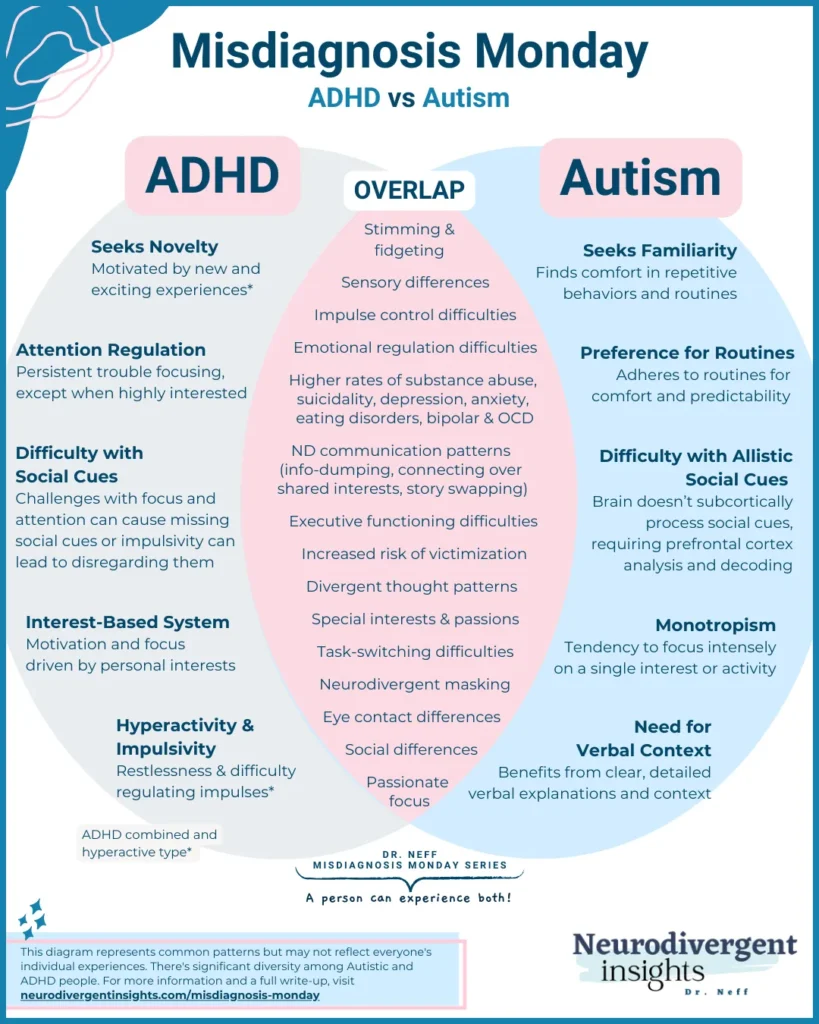
So, if autistics are cautious and ADHDers are bold, what happens when you have both? How can you define your AuDHD identity? How does an AuDHD person respond to the tightrope?
This balancing act illustrates the daily negotiation of an AuDHD person.
How Can We Change Our Perception of AuDHD?
Firstly, we need to start representing all types of autistic and ADHD people in our media, and these people need to be played by autistic, ADHD or AuDHD actors. This also means that we need a far more inclusive entertainment industry that accommodates these neurotypes to make it accessible for them to even be part of the community.
Secondly, we need to start watching our language. Less minimalising, less attaching this neurotype to people like it’s a personality flaw.
We don’t ‘have’ anything, we simply ‘are’. It is not a choice, it is not weakness, a bad state of mind, something we have to rub some dirt on, or man up to. It is as intrinsic as saying your age, ‘I am 10’.
Thirdly, recognise what we have to offer. We are this, we live with this all the time, and trust me, we often hate it too. But we have so much to offer in ways of creativity, in fresh perspectives, in understanding intricate systems, and not having the social barriers to be honest and tell you about it.
We make wonderful employees if you want innovation and ideas. But if you want rule-following Storm Troopers, that’s not us. We also make incredible entrepreneurs, but we might struggle with the boring bits – we need help sometimes.
Defining Your AuDHD Identity
It can be a struggle to find your AuDHD identity when you feel like you are two people crammed into one body. Your needs and desires never align; in fact, they often overwhelm the other half of you. Only part of you attends an event at a time, you bring out autism for its strengths and ADHD for its, yet you never feel complete being both because it rarely feels like the two can exist at the same time.
We need to see that we can succeed as who we are.
We need to feel like we can have an AuDHD identity and be understood.
We need to understand that it is okay to feel, experience, live and contribute to life as all of ourselves.
So, if you have AuDHD and you find it hard to grapple with your identity, know that it is perfectly normal.
You are not two people or two minds crammed into one; you are just ‘too much’ and that’s amazing. Your AuDHD identity can be whatever you want, however and whenever you want, and most importantly, you are more than enough.
Read more about the two sides of AuDHD in my article Living with AuDHD: Not Two Sides of the Same Coin.