
4 million women watched me attempt to remove my IUD on TikTok — and the messages I received told a much bigger story.
The trend? We don’t know how to practice self‑advocacy at the doctor.
Women are often dismissed by doctors, gaslit, ignored, insulted, and not given informed consent when it comes to providing contraception—doctors don’t listen to women.
Ready for real-world advocacy tactics? Read the practical guide.
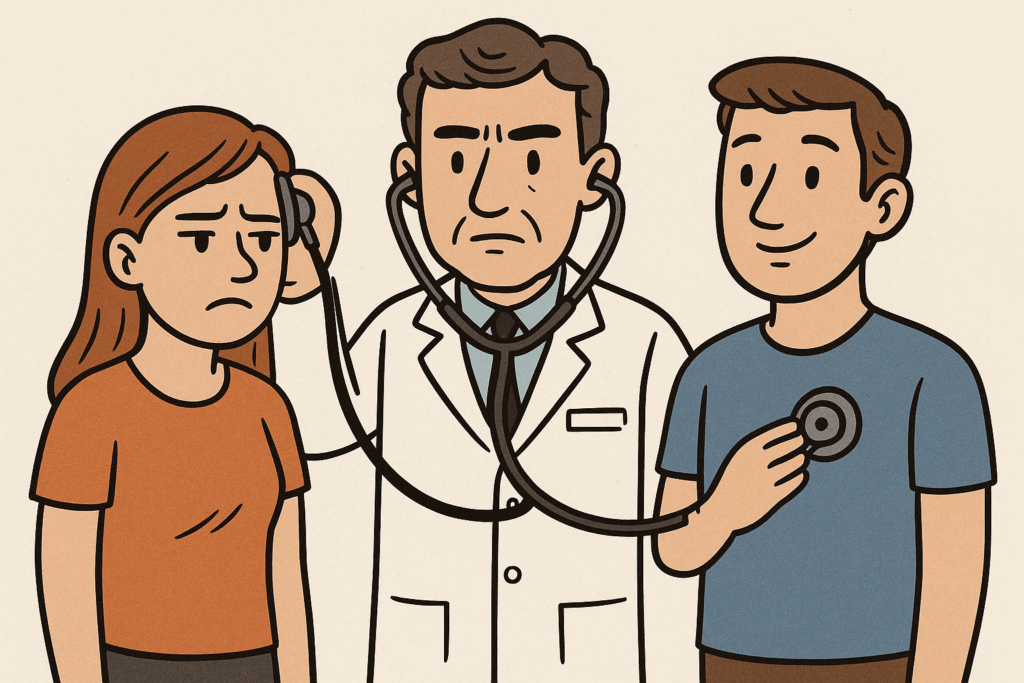
Women’s Symptoms Dismissed by Doctors
The Pill
I was never told what impact the pill would have on my body. I struggled with mental health issues and chronic pain, never knowing that a big part of why was the pill. For years, I thought I was the problem, whilst I was ignored by doctors. I feared that despite my upbringing, positive attitude and people who loved me, I was depressed. But it was never me, it was my hormones, largely because of the pill.
Implanon
After finding my endometriosis was no better with the pill, I had the Implanon put in my arm as an alternative. 3 months in and continuously bleeding, I asked the doctors to take it out. They said to wait. After 6 months of almost single-handedly funding Tampax and now becoming anaemic, they still wanted me to continue. 9 months in, they finally agreed to remove it.
Mirena
I had endometriosis surgery (a laparoscopy with ablation), and they suggested they would put the Mirena in whilst I was under, another option to help with my symptoms. They never gave me informed consent; they never explained that the Mirena was like a wall plug going through my cervix!
They mentioned small risks, but didn’t truly explain that it could be embedded in my uterine wall, that it could cause infertility, that taking it out could be the most painful thing I might experience.
Depo Injection
Still suffering from endometriosis pains, I had the injection Depo, as well as still using the Mirena. By this time, I was becoming smarter. I asked about side effects; I asked about potential issues. I asked, and they brushed it off. I was smarter, but still not vigilant enough. They brushed off the fact that it decreases your bone density, that prolonged use can lead to osteoporosis.
Hypocritical, Not Hippocratic Oath
This isn’t to mention the time a doctor removed a mole without waiting for the anaesthetic to work and ignoring me when I told him it hurt.
This doesn’t include a doctor telling me to stay with my boyfriend who was unhealthy for me because it was ‘stable’.
This doesn’t take into consideration the years I was dismissed by doctors and kept on antidepressants that I didn’t actually need!
The winner, of course, being multiple doctors telling me to get pregnant when I was 20 and single because it would ‘cure endometriosis’!
If I listed all the ways that doctors had wronged me, I would likely be able to write an entire book! Doctor’s dismissal of women is apparently worthy of TikTok virality, almost 4 million views isn’t an accident, it’s identification, relatability, and a bunch of pissed off women!
Contraception Side Effects
Contraceptive side effects in women can be life‑altering. If I listed all the side effects that these contraception options have on the body, you would be horrified!
We all know, every medical treatment today has a ‘potential side effects list’ a mile long. The thing about these is that they aren’t ‘potential’, they are likely.
Yet women’s symptoms are constantly dismissed by doctors!
They are what women are living with dis-ease and negative symptoms every day, because of a lack of funding, research, and just basic human respect for women in the medical field for the last 100 years; and we are still catching up!
Doctors need to do better! But until they do, here is how to advocate for yourself in healthcare.
Self-Advocacy at the Doctor
The number of women I have had message me to ask ‘how do I tell the doctor what I need?’ or ‘the doctors say no’ or whatever other version it is, where a woman feels small and a doctor is perceived as almighty, is astounding.
I, too, struggled with this for years. Even after I had them tell me to get pregnant to ‘cure my endometriosis’, I still respected the title of ‘Doctor’. Even years later, when I realised that doctors did not know my truth, and didn’t have my best interests in mind. I would still get sucked in like some insecure girl looking for male affection.
Why you Find it Hard to Advocate For Yourself at the Doctors
Women are told to ‘be nice’, ‘don’t make a fuss’, ‘play quietly’. Even our toys teach us to nurture and care for others, from toy babies to Barbies; it is all about looking after them. Do boys have to look after the emotions of their toy trucks and cars? Yet a girl gives her Barbie a haircut, and she is scolded for ‘making her sad’.

As teenagers, we have it drummed into us that our value lies not in our inherent worth, but in our beauty, sexuality and productivity. If you want a boy’s attention, dress like this, smell like this, put makeup on like this. TV shows, movies, even social media, with their flawless filters, make being ‘perfect’ the ideal. Women chase these ideals and can never attain them, all the while losing more and more of her inherent feminine power.
Finally, we reach adulthood – we explore with our sexuality, maybe find a partner, some have children, and then get trapped into toxic motherhood. Mum guilt plagues us, the majority of us needing to work and raise our children. Women still out perform men when it comes to domestic chores and child raising, even when both parents work.
We no longer have time to reflect, to look after ourselves, to honour our femininity. We are suffocated, like a candle being burnt at both ends, we burn bright like candle arbours, 20 candles going at a time, all burning down to the wick!

Advocacy is a Form of Self-Love
First, if you want tangible advice, check out my next post on How to Advocate for Yourself at the Doctor. But first, let’s be realistic; no advice can truly serve you until you know where you are, why you are, and who you want to be.
I suggest getting a book and writing down the answer to these questions because just thinking about them leaves them without concrete manifestations. Seeing something on a page is very different to thinking it in your head.
You can always save this page and come back to it, but ultimately, I would ensure you write or draw, or physicalise the answers to these questions in some way, even if that means just chatting with your best friend about them.
- Why do you fear asking for what you need?
- What is holding you back from standing up to doctors?
- What says you don’t deserve painless treatments?
- Is there any good reason that asking to be treated with kindness, respect, equity, and compassion should be anything other than how it should be?
You cannot shift how a doctor treats you, but you can shift your relationship with yourself so that you have strong, clear and decisive boundaries that gently demand respect.
Advocating for yourself is often less about the ‘how’, and more about the ‘why’. The ‘how’ doesn’t matter if you don’t believe in the ‘why’.
Once you firmly believe in your why, you know you are absolutely deserving of the utmost respect when visiting the doctors, you need to employ some strategies. Even the most strong-willed women, upon seeing their ex-boyfriends, will regress. We don’t want that in the doctor’s surgery.
You Are Worthy!
If today you only take one thing away, let it be this: you are worthy of respectful, informed care. But worthiness alone won’t sway a broken system—we unfortunately need to be responsible for our own care, because doctors rarely are.
When you’re ready for the “how,” read my next post How to Advocate for Yourself at the Doctor: A Guide for Women, or download my practical advocacy playbook, full of women’s health advocacy tips.
If you’ve experienced dismissal, you’re not alone. Share your story below or grab the self-advocacy playbook — because change starts with truth.
Get Your Free Guide
What you will get in the Free Doctor‑Visit Checklist
Ever leave an appointment thinking “Wait… I didn’t ask half my questions, I forgot the referral, and the doctor didn’t answer my question”?
This printable, neurodivergent‑friendly document walks you through every stage so that never happens again.
Inside you’ll get:
- Before‑the‑visit prompts – space to write why you’re going, your top 1‑3 concerns, and the boundary you want to hold
- Conversation scripts – polite‑but‑firm lines to redirect interruptions or push back on “It’s probably just stress”
- Plain‑language questions – easy sentences to ask for test explanations, result print‑outs, and next steps
- During‑visit checkpoints – quick reminders so you don’t freeze mid‑consult (“Finish your story first.”)
- After‑visit debrief + tracker – space to note follow‑ups, next‑action dates, and who’s holding you accountable
- Sensory‑friendly layout – icons, soft colours, and big open lines so you’re not visually overwhelmed
Print it, keep it in your Notes app, or hand it straight to your support person on the day — your call.