
Neurodivergent burnout is different; it isn’t being tired; it isn’t that your social battery is out. It is a whole-body shutdown. It is the complete inability to do things for yourself, even if it is in your best interest. And I don’t mean not going to the gym even though you want to be healthy; I mean being unable to eat because the thought of walking into the kitchen, let alone just microwaving a disgusting frozen meal, feels insurmountable.
It is not laziness; it is not depression. It is, neurodivergent burnout!
If you are neurodivergent and experience waves of complete shutdown, exhaustion, and it seems like no matter how much you sleep, you never feel okay.
That you are always sick.
If you find that you have periods of feeling like a superhero, only to be met with kryptonite-level weakness after, this is for you.

I never forget at 14 years of age, having anxiety about going out with my friends on Saturday for a fun day out. I remember thinking so actively (with my superior pattern recognition skills, I didn’t know I had) that I didn’t want to go.
I’d worked out that the better one day was, the worse the next one would be. I figured it was some kind of cosmic balance thing, maybe even a curse, that meant happiness always came with a price. Turns out, I was just undiagnosed and living with AuDHD. Nevertheless, this cycle of burnout began as a child… and if a fourteen-year-old girl with limited responsibilities in life feels it, us adults are screwed!
The Science Behind Why Neurodivergent People Experience Burnout?
Neurodivergent burnout is a chronic state of exhaustion. It is often caused by the excessive toll this world has on neurodivergent people. People with ADHD and Autism spend so much more energy processing the world we live in.
As teenagers, we go through something called synaptic pruning. Where the neurons we don’t use get pruned away. For example, think of every new piece of information in a particular genre as making a highway.
The highway you have for eating, big highway, do it all the time, the highway you need for algebra, most people prune that highway the minute the school term ends. Thing is, these neural pathways that most teenagers prune, doesn’t happen nearly as much for neurodivergent people, meaning we have the equivalent of London’s chaotic road system running in our head with all the side ally’s and backstreets and roundabouts, whilst those who aren’t neurodivergent get their map stripped back to the necessities, mirroring more of what the collective highway system of Australia looks like… sparse!
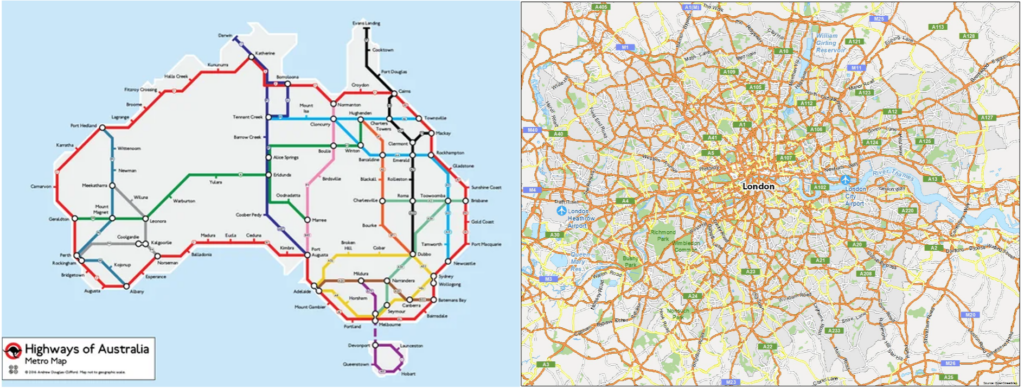
Neurotypical Brain vs Neurodiverse Brain
Think of it like this. A new piece of information is given to a neurodivergent person, think of it like a taxi driver picking up someone from the airport. The taxi sends that neurodivergent person through all of London’s backstreets to get them where they are going, and on the way, that neurodivergent person in the cab is exposed to smells, sounds, traffic lights, and the whole of bloody London. Whilst a neurotypical person, they get out of the airport and are simply put on a highway right up until their destination, a few streets off the main road.
Who is going to be more exhausted? I know I would much prefer the highway drive to the constant barrage of 74 left turns and 65 traffic lights.
Every single piece of information, and I don’t mean knowledge, I mean information. Everything the senses can grasp cognitively or subconsciously has to pass through all of London before it is computed. This is why the co-morbidity rate between neurodivergent people and auditory processing disorder is so high. It takes a minute for the taxi to take all those back streets.
Why is Everyday Life So Exhausting for Neurodivergent People?
Neurodivergent burnout is caused by the prolonged masking, the sensory overload and the effort required to operate in this neurotypical world.
Imagine how hard it would be to read every book, every text message, every menu, upside down, all the time. That is the mental load dyslexia takes on a person.
Imagine how challenging it would be if all the clocks in your house were wrong and you had no idea how to work out the differences, or how long anything took to get to. Every game of cards caused stress. Every bank transfer, phone number, or price tag left you second-guessing yourself, never quite sure you had it right. This is how dyscalculia can feel.
Imagine having a perfectly planned out day where one thing flowed into the next, like a wedding: ceremony at 2 pm, photos at 3 pm, reception at 5 pm. Then your mad uncle came, crashed a car into the venue, and you had to adjust the entire plan on the spot, and then keep adjusting, all day long. Just as you had set everyone for dinner outside on chairs rather than inside with the rubble, it started to rain, so you adjusted again and again and again. This is what autism can feel like.
Imagine having two hours where you could conquer the world. You can pick up on every micro expression, get everything done, you have so much motivation that you feel like you could clean the whole house, reorganise the pantry, order new shelves for the bathroom online and design your garden for a full remodel. Then, after pulling everything out of your pantry, ready to clean and reorganise, you fall into a deep depressive state where you simply cannot carry on. Imagine the disappointment, the lack of achievement, the mess you now have to deal with, on an empty battery. This is what ADHD can feel like.
I know all of these feelings, and these are just one example from each diagnosis, because I have all of these neurodiversities. Then I wonder why I am burnt out?
What is Neurodivergent Burnout?
Neurodivergent burnout is when the systems, situations, experiences, taxes, expectations and responsibilities of life become simply insurmountable for a neurodivergent person, and we just cave under the weight of it.
It is like running a diesel car on empty. A neurotypical person (someone with unleaded) can easily run their car out of gas on the highway, take a short walk with a jerry-can and be back on the road. But if you have a diesel car, running it to empty causes significant damage by introducing air into the injection system, which in turn can break the injector.
When we spend too much energy on life, we don’t just run out of petrol; our entire engine shuts down.
We don’t just need some petrol; we need to get new parts in and wait for a full service, and then wait whilst the mechanic fixes the car.
Neurodivergent burnout is when we can literally not do even the most foundational of tasks without considerable, extreme, and often painful effort.
Signs and Symptoms of Neurodivergent Burnout
Neurodivergent burnout affects the whole person, and while every experience is different, there are common signs that show up across both the mind and the body.
Emotional and Cognitive Signs of Neurodivergent Burnout:
- Difficulty thinking straight
- Mental fog
- Lack of motivation beyond the normal difficulties
- Wanting to zone out, disappear, run away, be looked after
- Finding yourself easily irritated and unreasonable
- Not enjoying things that you usually would
- Emotional numbness
- Disconnected feeling from loved ones
- Not wanting to do anything, even comfort activities are boring
Physical and Behavioural Signs of Neurodivergent Burnout:
- Exhaustion that sleep won’t fix
- Inability to do basic things like eat, shower, and exercise
- Getting physically sick with colds, flus or headaches
- Feeling generally run down but never getting sick
- Being unable to get out of bed in the morning
- Experiencing sensory discomfort more strongly
- Avoiding leaving the house
What Does Neurodivergent Burnout Feel Like?
I rarely get into states of deep burnout now because I have organised my life with appropriate rest points, but I still experience small episodes that last 5 to 6 weeks. I often manage to maintain my basic functioning, but for those weeks, I will feel utterly shattered. No sleep is ever enough. I lack focus, attention and often joy. I find it extremely difficult to do new things, socialise and get out of the house. I sit at home on a lovely day and feel so angry at myself for not going for a walk on the beach while the weather is nice, yet I cannot bring myself to get in the car and travel the whole 5 minutes it would take to get me there. I eat the same weekly rotation of meals, but often forget to organise these ahead of time. That means more takeout, or unhealthy choices like packets of tiny teddies rather than my usual hummus and carrot, because the thought of peeling the carrots and making the hummus is just too much.
Generally, towards the end of the 5 to 6 week stint, I completely break down, needing 3 to 4 days essentially in bed, watching hours and hours of TV. Sometimes, if it is really bad, even the TV makes me feel terrible and I don’t even enjoy that. I eat packets of chips for dinner and don’t get out of bed until noon, not because I was asleep, but because I can’t work out what to eat for breakfast, and what’s the point of getting up if you aren’t going to eat, then what? I can’t work out what to do, I can’t prioritise my life, I can’t organise my thoughts. Nothing. I will even need to really build myself up to shower.

I have just started coming out of one of these deeper burnout experiences, and I didn’t wash my hair for a week. Which, for me, I cannot stand. It actually causes headaches somehow, and the sensory texture of it makes me constantly aware of it, which I hate. Yet even that discomfort wasn’t enough to push me to wash it.
Physical Symptoms of Neurodivergent Burnout
- Constant buzzing and vibration running through your body
- Eating habit changes
- Headaches, body aches and discomfort
- Body heaviness and pressure
- Speech difficulties
- Unrelenting tiredness
Sometimes, neurodivergent burnout feels like a full nervous system overload. We have electrochemical systems inside our bodies that transmit signals using voltage.
When I am burnt out, I feel like I am a 12-watt appliance put in a 24-watt charger.
There is just too much current for my body to have capacity for. I can genuinely feel the buzzing in my veins, mostly localised to my arms and torso, but it goes beyond a subtle vibration into something that feels uncomfortable and relentless. The best way I can describe it is this: if you have ever been on a long road trip or a flight, the noise and vibration of the vehicle is so constant for so long that when you finally get out, your body can still feel it humming. That is neurodivergent burnout in my bodyOther physical symptoms include suppressed appetite or cravings, an increase in headaches or body aches, and discomfort like restless legs or that bone-deep feeling of having been stuck on a plane for 12 hours.
And then there is the tiredness. All of it, all the time, and yet sometimes an inability to fall asleep on top of it.Body heaviness is another one that is hard to describe. It feels like you are a sack of bricks, like the flu without the flu. There is too much fluid in your limbs, you are pressing out of your skin, puffed up with internal pressure, but not in a cute balloon way. In a heavy, bloated, uncomfortable way.
It can also become more difficult to speak as my thoughts become jumbled, and I find myself playing articulate for half my vocabulary. ‘The thing you put on your head’ when I mean a hat. ‘The round, flat, Italian food.’ For pizza. It is exhausting when you can’t even express yourself because your brain has closed the doors on the word sorting library, and you can’t access half the words you own.
I also find I feel disappointed in myself, which brings a sadness that sits somewhere close to depression. I have got better at this over time and have a deeper acceptance of who I am, but I am still saddened when I get to this point. The work is in accepting it, feeling into it, and making sure it doesn’t take over completely.
Sensory sensitivity also spikes during burnout. Lights are brighter, noises are louder, textures are worse, clothes are tighter, labels scratchier, temperatures feel more extreme, even the hair on your head feels like it is pulling more and even your eyes feel dry and gritty, like you haven’t blinked in hours.
Neurodivergent Burnout vs Neurotypical Burnout
Regular burnout is often isolated to workplace stress. It can still have factors from home life as well, but the majority of regular burnout cases are work-specific, which means that if you remove the work, the person recovers quickly. Neurodivergent burnout is from all of life: eating, showering, working, exercising, socialising, and even getting dressed! All the executive function, all the decision-making fatigue, all the sensory issues just become too much. A neurotypical person can take a week off work, but a neurodivergent person cannot take a week off eating and showering.
Regular burnout often includes a lack of efficiency, fatigue and a deep, unhappy emotion such as cynicism, sadness, or depressive moods.
Neurodivergent burnout is a molecular-level exhaustion, the 99% of the atoms that make us up that is actually energy and not matter, even that is tired! We don’t just struggle to get to work or answer emails; we struggle to get out of bed or brush our hair.
Many neurodivergent people who truly deeply burn out find it is what gets them a diagnosis because they lose all ability to mask anymore. However, recovering from burnout can take years. It often results in reduced ability to work, sometimes even preventing work altogether.
While for most neurotypical cases a holiday or week off may help, or even changing jobs will shift it, a neurodivergent person will often require long-term reduction of demands with substantial sensory support.
Neurodivergent Burnout vs Depression
Now it is always important to speak to your doctor, but I have experienced both burnout and depression, and they can actually co-occur, which makes it very difficult to untangle. However, in the simplest way possible, the difference between burnout and depression is mood.
When I experienced depression, it was like being possessed. It wasn’t me that felt like I was in control. I knew I wanted to have a good time, I knew I liked going out, I knew I loved my mum, but I felt nothing. Numbness, emptiness, desire for nothing, total apathy. There was a disconnect between what I knew, which is how I felt I was truly, a wonderful, lucky, happy person, and how I actually felt. Miserable, sad and unmotivated.
While burnout still has many of the same feelings, the way they present is different. Burnout feels more like a system failure, a flu, a deep fatigue where you just can’t function properly. While depression makes you feel held captive in your body, your mind wanting to go to a party while your hormones and chemicals scream ‘NO’. Burnout is different. No part of you wants to go out. Not because you are sad, or because you want to but can’t. You just genuinely cannot. There is a different level of acceptance to it. It feels more like a physical disability than a mental one.
Someone in a wheelchair wouldn’t even bother trying to reach the top shelf. Burnout is like that. Depression is being able to reach it, but not having the willpower to lift your arm.
ADHD and Burnout
Having ADHD can often mean we don’t recognise the signs of burnout until we are already deeply in it. Executive dysfunction, having to spend so much energy on doing Every. Little. Thing. All. The. Time. Then, having hyperfocus cycles where we do so well, full throttle, full steam ahead, maximum capacity, and then the crash.
Neurodivergent people are the hunters of the past. While neurotypical people were great at staying consistent, looking after the harvest, following the seasons, and tending the fields daily, we lacked that consistency. Our optimal state was in the hunting, the attention to detail, the adaptive changes, the full focus on our prey for days, the hyperfocus needed for that, the staying up late to get the job done. We flourish in environments that allow us to work without time constraints, explore without limitations and focus without interruption. We don’t do well being told to tend the fields daily. We go where the animals go. Then we rest.
However, this world has us living every day in that agricultural doom. Our hyperfocus is limited, our ‘stay up until it’s done’ is restricted by our morning work schedule, our ‘follow the animal exploration’ is suppressed by spreadsheets, professional development and appropriate work conduct.
We are innately inconsistent people living in a world that rewards consistency. We don’t know how to operate without the high and the low. We simply go high and high and high and then crash.
How to Recover from Neurodivergent Burnout
I’m sorry to say, but it can take years to truly recover. I hit the depths of my burnout about five years ago. I couldn’t work, I had no social life, and rarely left the house for about eight months. My husband did all the shopping, lots of the cooking, most of the cleaning, and I had no hobbies outside the house. I was also experiencing chronic endometriosis at the time, but to say I did pretty much nothing for eight months is pretty accurate.
I was lucky enough to actually be able to do this and be supported through it; not everyone is. I remember when I started working two days a week, wishing I was sick every morning I had work, pleading with my body that I was unwell so I didn’t have to go. And my job wasn’t hard. It was with people I liked! But that is how burnt out I was.
I built myself back up to the point where now I understand my warning signs a bit better, manage myself more, and just generally look after myself. Though it still requires vigilance, self-awareness, and the deep-rooted belief of feeling good enough. That metacognition of ‘am I in a high?’ ‘Am I doing too much?’ ‘Is this sustainable?’ ‘How much do I ride this happy wave, and how much do I pull back so I’m not worn out?’
It is not easy to manage yourself when you are feeling good. It feels like a rip-off. You finally have all this motivation and endorphins, and you feel like you have to limit yourself and let it out on rations. You may choose to simply ride the high, and that is fine too, but it is important to include lots of small breaks along the way, or you will likely end up back in the depths of despair again.

It is simply, and not so easily, about listening to your body. Rest without guilt, set boundaries (do you really want to go to that event, will it fill you up or drain you?), what can you do to look after your nervous system (reduce driving, cut back on some of the expectations of life?), what small acts can you put into your every day or, inconsistent as we are, every week, that allows you to recover? There is no perfect formula, but small, intentional acts of self-protection add up more than you think.
Honouring Yourself Through Neurodivergent Burnout
Neurodivergent burnout is much more than most people realise. It isn’t just fixed with a week off work, and if you are truly shattered, it isn’t even fixed in a year. It can take years to recover from neurodivergent burnout because it often takes years to build up to. Once someone is there, they will often need to learn to be mindful of how to avoid it in the future. We don’t want to live in a cycle of highs and lows, feeling like we can never trust our bodies with our best interests. We need to look after ourselves and accept that we do work differently, and honour that. This looks different for everyone, but managing or avoiding burnout isn’t a weakness. It is an unfortunate neurodivergent tax we often have to pay that most of the population will never truly understand.
Neurodivergent burnout isn’t laziness, it isn’t weakness, and it isn’t even bad management. It is the culmination of years of living in a world not designed for us and working our absolute best to be part of it. Now, it is about making the world, your world, fit you.
FAQ
What is neurodivergent burnout?
Neurodivergent burnout is a chronic state of exhaustion caused by the prolonged effort of navigating a world not designed for neurodivergent people. It is not laziness, it is not weakness, and it is not bad management. It is what happens when the systems, situations, expectations and responsibilities of life become simply insurmountable, and we cave under the weight of it.
How long does neurodivergent burnout last?
Neurodivergent burnout can last anywhere from a few weeks to several years, depending on how long it took to build up and how much rest and support the person is able to access. Unlike regular burnout, you cannot just take a week off work and recover. Because neurodivergent burnout comes from all of life, recovery requires a long-term reduction of demands and genuine nervous system support.
Is neurodivergent burnout the same as depression?
No, though they can co-occur, which makes them difficult to untangle. The simplest difference is mood. Depression often feels like being held captive in your body, wanting to engage with life but feeling nothing. Burnout feels more like a system failure, a deep physical and cognitive exhaustion where no part of you has the capacity to function. Always speak to your doctor if you are unsure.
What are the signs of neurodivergent burnout?
Common signs include exhaustion that sleep won’t fix, an inability to do basic tasks like eating and showering, increased sensory sensitivity, emotional numbness, difficulty speaking or finding words, and a complete withdrawal from things you usually enjoy. If you are finding that even your comfort activities feel like too much, that is often a sign you are deep in burnout.
Can you recover from neurodivergent burnout?
Yes, absolutely. It takes time, self-awareness and a willingness to listen to your body, but recovery is possible. It often means learning your warning signs, building in rest without guilt, reducing unnecessary demands, and accepting that you do work differently from most people. Managing burnout is not a weakness. It is an unfortunate neurodivergent tax, and learning to pay it on your own terms is one of the most important things you can do for yourself.
Victoria-Rose Paris is an Adelaide-based AuDHD content creator sharing lived experiences of neurodiversity. With a history of endometriosis and a focus on living life to the fullest while honouring her neurodiverse self, she navigates identity, productivity, travel, health, and adventures. She is also the founder of The Adulting Club, where neurodivergent people bring their “too hard basket”, and she brings the education and dopamine. Find her raw, unfiltered content on Instagram and TikTok.